



Vertical Scaling Meta Ads, Facebook Ad Scaling, Meta Advertising StrategyWhat is “Vertical Scaling”? It’s a strategy for scaling up advertising by directly increasing the budget of an existing, well-performing campaign or ad group.
Vertical Scaling is the most common and traditional scaling strategy in Meta advertising, also known as the “number one scaling strategy.” The definition of vertical scaling is: a strategy for scaling up advertising by directly increasing the budget of an existing, well-performing campaign or ad group.
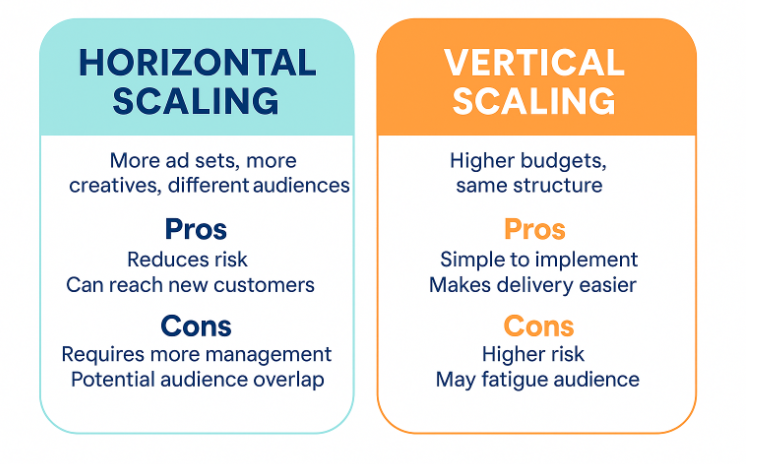
The following is a detailed explanation of this topic, covering its mechanisms, implementation methods, risks, and positioning in the current Meta algorithm environment.
Vertical Scaling Definition and Mechanism 📈 Core Mechanism: Budget Increase
The core of vertical scaling is increasing the budget on existing, high-performing ad assets.
If an ad group or campaign’s data (e.g., ROAS) reaches your profitability target (e.g., the minimum ROAS is 2, and the campaign reaches 3), you can start considering vertical scaling.
This contrasts with horizontal scaling, which achieves scaling by replicating successful ad groups and making modifications (e.g., changing targeting or creatives).
Meta’s Advantage Shopping Campaigns (ASC) are generally easier to scale vertically because you can increase the budget without immediately losing ad performance.
Focus on Objectives: Vertical scaling typically focuses on CBO (Campaign Budget Optimization). Typically, media buyers aim to vertically scale their daily CBO budget to $1,000 or more per day. Implementation Methods: Smooth vs. Aggressive Strategies ⚙️
Successful vertical scaling lies in smoothness and calculated risks, not in aggressive, blind operations.
A. Smooth Scaling
This is the most recommended and lowest-risk method, designed to respect the algorithm’s learning phase and avoid over-increasing the system’s load:
Regular Scaling: Increase the budget by 20% to 50% every 24 to 48 hours.
ROAS-Based Decisions: The increase depends on your profit margin. If your campaign’s ROAS is very high (e.g., 4), you can take a more aggressive scaling approach (30% to 50%); if your profit margin is smaller (e.g., the minimum ROAS is 2, currently 2.65), you should increase conservatively (20% to 30%).
Gradual Scale: Scaling takes time. For example, it takes six months for some accounts to grow from a monthly expenditure of 20,000 to 60,000.
B. Aggressive Strategy: Wave Surfing
While aggressive daily budget increases are not recommended, “Wave Surfing” is an advanced vertical scaling strategy that capitalizes on favorable market timing.
Mechanism: Advertisers identify the most profitable days or time periods (e.g., peak times on Sundays or Black Friday) by analyzing Shopify sales data and historical patterns.
Purpose: During these high-value periods, advertisers aggressively increase their budgets (e.g., from 7.5K to 10K) to maximize daily revenue.
Risk Management: This approach is risky and could disrupt the learning phase or destabilize the campaign, but because it offers the highest probability of success, this “calculated risk” is worth taking.
Risks and Challenges of Vertical Scaling ⚠️
Vertical scaling is one of the most common reasons advertisers encounter problems during scaling.
C. ROAS will inevitably decrease
When you increase your budget, your ROAS will almost certainly decrease.
Reason: Increasing the budget forces the algorithm to seek a broader audience, some of whom may have a lower conversion rate than the core audience.
Goal: The key question is whether ROAS drops to 1 or 2, or remains at 5. As long as ROAS remains above the break-even point, scaling is worthwhile.
D. The Penalty of Over-expansion
Scaling Too Fast is a common mistake.
Consequences: Continuously doubling your budget (e.g., increasing it by 100% daily) is unsustainable; the machine will penalize you, causing campaign disruptions.
Disrupts Learning: Rapidly increasing the budget places excessive demands on the algorithm, interrupting its data accumulation and learning process.
Balancing Horizontal Expansion
In an era where Andromeda algorithms emphasize creative diversity and signal quality, relying solely on vertical expansion is insufficient.
Advertising professionals must find a balance between vertical and horizontal expansion.
When a campaign reaches its budget cap through vertical expansion (e.g., $1,000/day), further vertical expansion will lead to deterioration. At this point, horizontal expansion (i.e., copying the winner and making modifications) is needed to find new, non-overlapping traffic and continue driving growth.

